
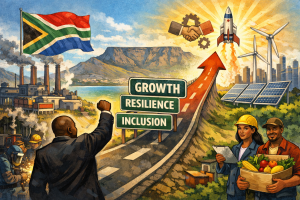
Johannesburg, South Africa: A radio commentator accused officials in the Department of Trade, Industry and Competition (the dtic) of “sabotaging” their Minister by proposing what were described as overly ambitious and unachievable industrial targets. Personally, I think we need to respectfully but firmly reject this notion that seems to suggest ambitious administrators set their political principals for failure.
Let us start with clarity: ambition in policy is not sabotage. It is a necessary ingredient for transformation in a country whose economy must urgently shift from stagnation to growth, from dependence to resilience, and from exclusion to inclusion. The targets the DTIC presented were not fantasy figures. They were grounded in strategic intent, backed by empirical evidence, and driven by a realistic understanding of South Africa’s industrial potential.
A National Imperative: Reindustrialisation
South Africa’s reindustrialisation is not a theoretical aspiration, but a necessity. The country cannot sustainably grow jobs, build exports, or reduce inequality without a vibrant and inclusive industrial base. The global economy is undergoing a structural shift, and for South Africa to remain relevant and competitive, it must move swiftly to rebuild productive capabilities and increase value-added exports.
That is what the department’s industrial policy framework seems to be doing: expand manufacturing, deepen supply chains, foster localisation, and attract private-sector investment. This approach seems to be targeting high-potential sectors such as automotive, green energy, agro-processing, pharmaceuticals, and digital technologies.
Ambitious? Yes, but more Strategic!
Ambition must be understood in context. The DTIC seems to have set targets for increased local content, job creation, black industrialist support, and export growth. For me it did not seem like they presented arbitrary figures pulled from the air. They were the result of months of sectoral analysis, consultation with industry stakeholders, and alignment with broader national plans, including the Economic Reconstruction and Recovery Plan (ERRP), the Just Energy Transition Framework, and the Presidential Investment Mobilisation Drive.
To illustrate: South Africa’s localisation masterplans, developed with business and labour, have already begun delivering results. The Black Industrialists Programme has supported over 200 projects, unlocking billions in investment and creating thousands of jobs. And the new Industrial Transformation Fund, developed in collaboration with public and private partners, will provide catalytic capital to support industrialisation in underserved areas.
These are not dreams, but rather interventions already in motion.
A Whole-of-Society Effort
I do not understand their targets to be for government alone to achieve. They require partnerships with business, labour, and civil society. The department’s role is to provide policy coherence, remove barriers, and de-risk investment. But the energy of business, local entrepreneurs, the commitment of labour, and the confidence of investors will be the real drivers of delivery. South Africa has done this before. From the development of the automotive industry to the successful rollout of renewable energy IPPs, our country has shown that bold targets, when matched with smart policy and shared commitment, can deliver transformative outcomes.
Holding the Line on Hope
Of course, public servants are duty-bound to be both realistic and visionary. It would be easier, politically and administratively, to set unambitious targets that guarantee mediocre outcomes. But South Africa cannot afford timidity. The times we live in call for bold leadership and courageous execution.
Rather than ridicule the resolve of strategically courageous officials, let us interrogate every plan, strengthen partnerships, and hold one another accountable for results. The path to reindustrialisation will not be easy, but it is achievable if we walk it together as a nation, with clarity of purpose and shared determination.
Let us not confuse ambition with sabotage. Let us, instead, call it what it is: an urgent act of national faith in South Africa’s future.
In just the last 3 years:
- Over R332 billion in investment pledges were secured via the Presidential Investment Drive.
- The Black Industrialists Programme supported 230+ firms, creating more than 35,000 jobs.
- Our sector-specific Masterplans (automotive, clothing, steel, agriculture, etc.) have triggered real localisation wins like the 60% local content in new taxi production.
The Industrial Transformation Fund is set to unlock catalytic investment, particularly for black and women-owned manufacturers in underdeveloped regions.
These targets are not pipe dreams. They are aligned to national frameworks, backed by data, and designed with industry input. In a country with high unemployment, a fragile industrial base, and vast untapped potential, cautious incrementalism is the real risk.
I for one do not believe that we are in the business of setting safe, low-impact goals. We are building a reindustrialised, inclusive economy, and that requires bold vision backed by execution.~